Industry Central land swap
The Industry Central Land Swap project is a strategic solution to assist selected businesses located within the high flood risk zone in the existing South Murwillumbah industrial estate to relocate to flood free land at Lundberg Drive (Industry Central) via a land swap agreement.
The Industry Central Land Swap project was created following the 2017 flood, caused by ex-tropical cyclone Debbie, which devastated businesses in the South Murwillumbah industrial zone.
Tweed Shire Council acquired 14.02 hectares of land, thanks to funding support from the NSW Government as part of an unprecedented move to mitigate against climate change and create resilience for local businesses and the broader economy.
This initiative enabled eligible landowners directly impacted by the 2017 flood in the Tweed to enter an expression of interest (EOI) process and, if successful, swap their flood-prone land with Council-owned flood free land at Industry Central, South Murwillumbah.

Aerial view looking east across South Murwillumbah – 2017 flood.
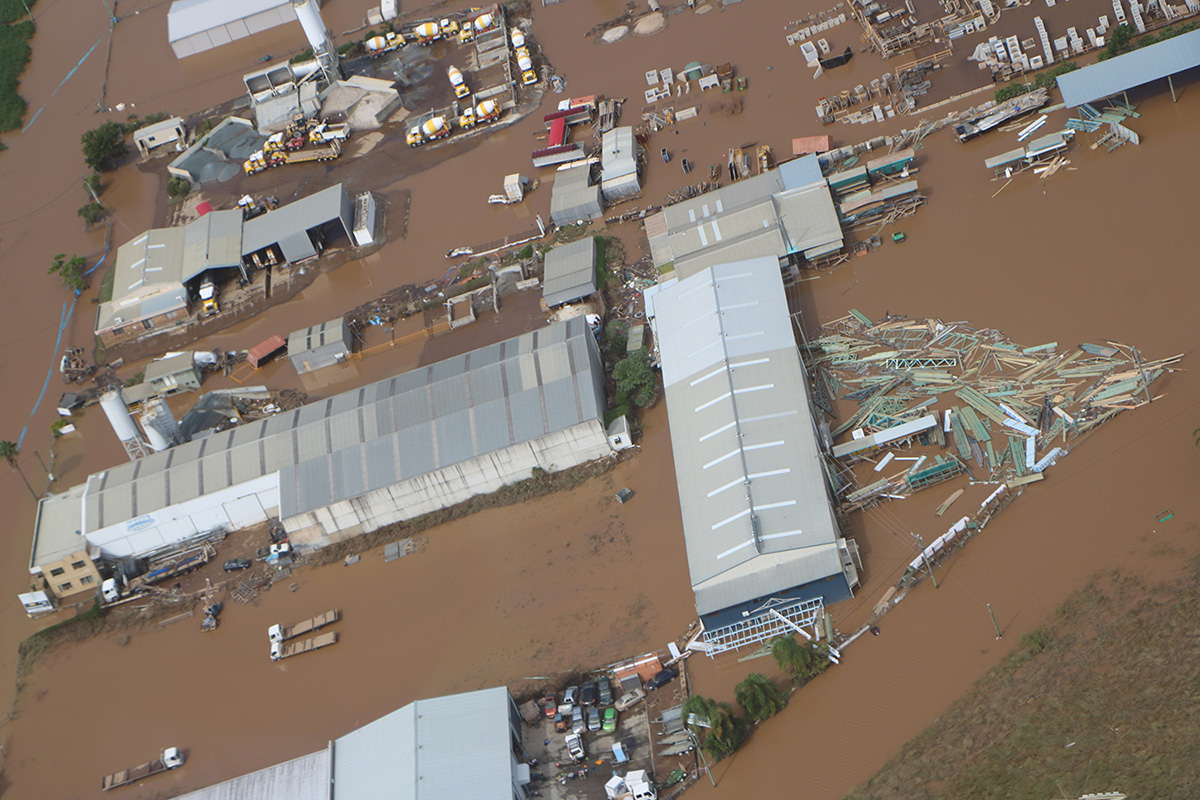
Aerial view of Murwillumbah Industrial Estate – 2017 flood.

Industry Central land area during the 2022 flood.
Council sought expressions of interest from businesses looking to move.
The initial round of EOIs saw 5 successful applicants signing the Land Swap Agreement and moving to Industrial Industry.
Council will also be moving its works depot to the precinct from its current South Murwillumbah location.
The floods of 2022, even bigger than the floods of 2017, prompted more businesses to consider a move to flood-free land at Industry Central.
In 2023, Alder Constructions was awarded the contract for the development and construction at the new land at Industry Central which was completed in early 2025.

Earthworks at start of the precinct development, October 2023.

Completed earthworks at the Industry Central site, January 2025.
The aim of the Industry Central Land Swap project is to build resilience into the Tweed economy to overcome future flood events and in turn help the town better face the ongoing challenges that climate change will present.
Council is looking to expand its flood-free industrial land precinct with future projects:
Quarry Road
The Quarry Road industrial subdivision is a 32-lot industrial subdivision located in South Murwillumbah with road access from Lundberg Drive and Quarry Road. The development has been predominately undertaken as a partnership between Jiggar Pty Ltd and Tweed Shire Council.
Development consent for a 35-lot industrial subdivision was originally issued on the 28 June 2012 over the subject land but unfortunately this approval was not commenced within the 5-year statutory time limit and the approval lapsed on the 28 June 2017.
A new joint development application for a 32-lot industrial subdivision prepared on behalf of Council (as landowner) and Jiggar Pty Ltd was lodged in November 2019. This application was subsequently approved by Council on 19 April 2021.
Prior to the land being approved for industrial development, the land was classified as extractive industries. Jiggar Pty Ltd and Council operated independent quarries producing road gravels and quarry products over this land.
PEL Area 6
In a significant step towards bolstering employment land supply, Council has resolved to initiate a comprehensive planning proposal to rezone an area of land known as ‘PEL Area 6’ to support additional employment-generating uses.
The site adjoins the existing Industry Central estate in South Murwillumbah and is jointly owned by Tokara Pty Ltd and Tweed Shire Council.
The proposal seeks to rezone the land for a combination of employment-generating uses and environmental conservation. It will be submitted to the NSW Department of Planning for assessment, ahead of a public exhibition period during which community feedback will be sought.
In an effort to balance economic development with environmental protection, a significant portion of the Council-owned land will be allocated for a Biodiversity Stewardship Agreement.
This agreement is intended to offset the environmental impact of development on other parts of the site, enabling a more orderly development outcome while safeguarding and protecting areas of high ecological value.